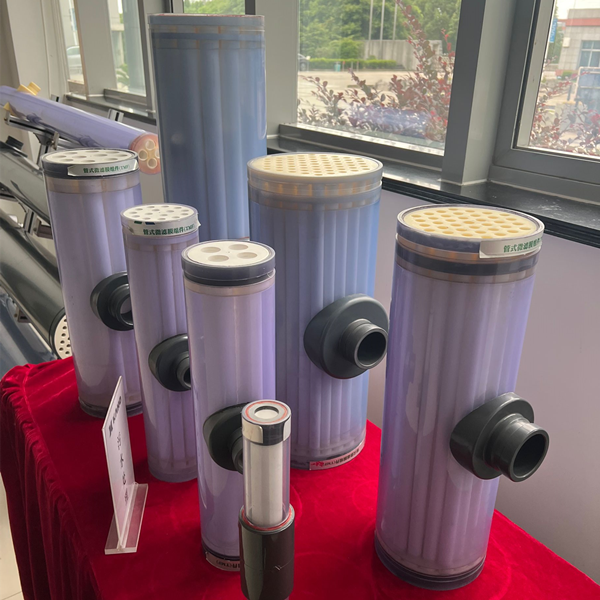
In industrial production and environmental treatment, efficient solid-liquid separation is a critical link that directly affects product quality, environmental compliance, and operational costs. Traditional separation methods (such as sedimentation tanks, sand filters, and plate-and-frame filters) often suffer from drawbacks like large footprint, low efficiency, heavy chemical usage, and unstable effluent quality. Tubular microfiltration (TMF) membranes, as a cutting-edge separation technology, have emerged as a game-changer—offering precise filtration (0.05-1.0μm), chemical resistance, and automated operation. From wastewater treatment in textile factories to acid recovery in LCD plants, TMF membranes are redefining efficiency and sustainability across industries .
Core Principles & Structural Advantages of Tubular Microfiltration Membranes
1. Working Principle: Pressure-Driven Precision Separation
TMF membranes operate on a pressure-driven mechanism (typically 0.01-0.3 MPa), using asymmetric porous structures to separate solids from liquids. The key innovation lies in cross-flow filtration: the feed liquid flows tangentially across the membrane surface at high velocity (≥4.2 m/s in acid recovery applications), creating a scouring effect that prevents contaminant accumulation and membrane fouling . Unlike traditional dead-end filtration, this design allows continuous operation even with high-suspended solid (SS) feeds (up to 5% SS concentration), making it ideal for complex industrial wastewater .
2. Material & Structural Features
Common membrane polymers include polyvinylidene fluoride (PVDF), polysulfone (PS), polyethersulfone (PES), and polyamide (PA). PVDF is preferred for harsh conditions due to its excellent chemical resistance (pH 2-13) and thermal stability (up to 95℃) . Asymmetric membranes (dense surface layer + finger-like support layer) dominate industrial use: the surface layer (≤0.1μm thick) provides precise filtration, while the 200-250μm support layer ensures mechanical strength. Module diameters range from 1" to 10", with single-module membrane areas up to 4.8 m² and system capacities exceeding 500 m³/d . Epoxy-free encapsulation is critical for corrosive media (e.g., HF acid in LCD manufacturing) to prevent leakage and ensure long-term reliability .
3. Unmatched Technical Advantages
TMF membranes offer significant space-saving benefits, with a modular design that reduces footprint by 70-80% compared to sedimentation tanks—making them ideal for retrofitting old plants. They enable chemical-free operation by eliminating flocculants (e.g., PAM) and coagulants, avoiding secondary pollution and preserving product purity (especially valuable for applications like acid recovery). With filtration precision ranging from 0.05-1.0μm, they remove 99.9% of bacteria, viruses, colloids, and suspended particles, resulting in effluent turbidity ≤0.1 NTU for stable water quality. In closed-loop systems, water recovery approaches 100%, and concentrated solids can often be recycled (such as glass sand in LCD production). Additionally, PLC-controlled operation allows for full automation, with automatic backwashing (air + water) every 30-60 minutes (60-90 seconds per cycle) and chemical cleaning only every 10-20 days, minimizing maintenance requirements .
Key Applications: From Wastewater Treatment to Resource Recovery
TMF membranes excel in diverse industries due to their adaptability to complex feeds. Below are proven use cases:
1. Industrial Wastewater Treatment
In the textile industry, TMF membranes remove fiber debris, dyes, and slurry from printing/dyeing wastewater, reducing COD by 30-50% and enabling water reuse as process water or cooling water. For mining and metallurgy applications, they efficiently treat heavy metal-containing wastewater (e.g., lead, copper) without chemical addition, meeting strict discharge standards like GB 8978-2018 in China. In chemical and pharmaceutical production, TMF membranes separate catalysts, colloids, and organic impurities from process streams, ensuring product purity and reducing solvent waste .
2. Resource Recovery
A standout application is acid recovery in LCD manufacturing: POREX TMF membranes recover 95% of HF/HCl mixed acids from glass etching wastewater, reducing raw material costs by 40% and solid waste by 60%—a Nanjing LCD plant has operated this system stably since 2016. In the food and beverage industry, TMF membranes concentrate fruit juices, separate fats from dairy products, and purify edible oils while preserving natural flavors without thermal damage .
3. Pretreatment for Advanced Processes
For reverse osmosis (RO) pretreatment, TMF membranes replace sand filters, carbon filters, and ultrafiltration (UF) systems, providing stable feed water (SDI <3) for RO membranes and extending their lifespan by 50%. In seawater desalination, they reduce suspended solids and biological fouling, allowing the use of standard high-pressure pumps and anti-pollution RO membranes—lowering capital costs by 20% .
4. Drinking Water Production
TMF membranes replace traditional coagulation-sedimentation-filtration processes, producing chlorine-free drinking water (avoiding trihalomethanes) with turbidity U. This makes them suitable for small-to-medium water plants and remote areas where reliable water quality is a priority .
Technical Specifications & Selection Guide
Choosing the right TMF system requires matching parameters to your specific application needs. Start with filtration precision: 0.05μm is ideal for high-purity applications like acid recovery, while 0.1-1.0μm works well for general wastewater treatment. Consider operating conditions such as temperature (-5 to 95℃), pH (2-13 for PVDF membranes), and feed SS concentration (up to 5% for most industrial use cases). System capacity should be calculated based on daily treatment volume—for example, 500 m³/d for large industrial plants and 10-100 m³/d for small facilities. Module size selection aligns with flow requirements: 1"-3" modules for small systems and 4"-10" modules for high-flow applications .
Follow this selection checklist for optimal results: First, analyze feed water characteristics including SS, pH, temperature, and specific contaminants. Next, define clear effluent requirements based on discharge standards or reuse purposes. Calculate the required flux—typically 50-150 LMH for wastewater and 100-300 LMH for clean water. Choose the appropriate membrane material: PVDF for corrosive media and PES for food or pharmaceutical applications. Finally, opt for a modular design to accommodate future capacity expansion .
Maintenance & Troubleshooting Guide
Proper maintenance extends membrane lifespan (3-5 years) and ensures stable performance. Routine maintenance includes automatic air-water backwashing every 30-60 minutes (60-90 seconds per cycle) to remove surface fouling. Chemical cleaning (CIP) is necessary periodically: acid cleaning with citric acid or HCl (pH 2-3) targets inorganic fouling like scale and iron oxides every 10-15 days, while alkaline cleaning with NaOH + NaClO (pH 10-11) addresses organic fouling every 15-20 days. Monitor flux regularly—if it drops by 30% or transmembrane pressure (TMP) exceeds 0.3 MPa, perform immediate chemical cleaning .
For common issues, here’s how to troubleshoot: Membrane fouling often stems from low cross-flow velocity or high SS concentration—resolve this by increasing the flow rate to ≥4 m/s and pre-filtering large particles. Leakage may indicate poor sealing or membrane damage, so replace seals and inspect membranes for tears using integrity testing. Low effluent quality can result from membrane pore blockage or incorrect precision selection—conduct chemical cleaning or upgrade to a smaller pore size. High energy consumption is typically caused by excessive TMP or improper pump selection; optimize the backwash cycle and use variable-frequency pumps to address this .
Comparison: TMF Membranes vs. Traditional Filtration
Compared to traditional methods like sedimentation tanks combined with sand filters, TMF membranes offer substantial advantages. Their footprint is only 20-30% of traditional systems, making them far more space-efficient. Effluent quality is consistently stable (turbidity ≤0.1 NTU) versus the variable results (turbidity 1-5 NTU) of traditional methods. TMF membranes require no chemical additives, while traditional systems rely heavily on flocculants and coagulants. Operation is fully automated with TMF, reducing labor demands, whereas traditional filtration is labor-intensive. Water recovery rates reach ~100% with TMF, compared to 70-80% for traditional methods. Maintenance is also lower with TMF (annual chemical cleaning) versus the high maintenance needs of traditional systems, which include frequent backwashing and sludge disposal .
Future Trends: Smart & Sustainable TMF Technology
The future of TMF technology is focused on smart and sustainable innovations. Material innovation includes the development of graphene-enhanced membranes for higher flux and improved chemical resistance. Intelligent monitoring systems integrated with IoT will provide real-time tracking of TMP, flux, and fouling, enabling predictive maintenance to minimize downtime. Energy efficiency is a key focus, with low-pressure membranes (0.01-0.1 MPa) designed to reduce power consumption. Additionally, TMF is increasingly integrated into circular economy models, with enhanced resource recovery (e.g., heavy metals, solvents) to achieve zero liquid discharge (ZLD) .
Final Thoughts: Invest in TMF for Long-Term Value
Tubular microfiltration membranes are more than just a filtration solution—they are a strategic investment in operational efficiency, environmental compliance, and resource sustainability. Whether you’re treating high-salinity wastewater, recovering valuable chemicals, or upgrading your water treatment plant, TMF technology delivers consistent performance, reduced costs, and a smaller environmental footprint. By choosing the right system and following proper maintenance practices, you’ll unlock significant ROI and stay ahead of evolving regulatory requirements.
Ready to implement TMF technology? Our team of experts offers customized solutions, from feasibility studies to turnkey systems. Contact us today for a free consultation and quote!