close
Choose Your Site
Global
Social Media
Views: 0 Author: Site Editor Publish Time: 2026-11-21 Origin: Site


All filtration systems experience fouling over time. However, a sudden or accelerated tubular membrane flux decline points to a deeper issue. It usually indicates a severe misalignment in operating parameters or an imminent module failure. In high-solids wastewater and industrial processing, operators often rely on a single metric. They might react purely to a sudden drop in permeate flow. This narrow approach leads to highly inaccurate diagnoses. It wastes precious resources on unnecessary chemical cleaning (CIP). It also forces premature equipment replacement.
To truly understand system health, you need a holistic view. Operators and engineers must evaluate the triad of crossflow velocity, transmembrane pressure (TMP), and fluid temperature simultaneously. By reading these three critical factors together, you can determine your exact next steps. You will learn whether your system requires minor process optimization, aggressive chemical recovery, or full module replacement.
Data Correlation over Isolation: Permeate flux decline must be normalized for temperature; a drop in flux might simply be a drop in fluid temperature increasing viscosity, not actual membrane fouling.
TMP is the Deciding Metric: Tracking TMP against crossflow velocity determines if flux decline is driven by cake layer buildup (reversible) or internal pore plugging (irreversible).
Material Durability Dictates ROI: If aggressive CIP regimes fail to restore baseline flux, upgrading to a chemically robust PVDF membrane element is often more cost-effective than continuous downtime.
Evidence-Based Replacement: Before sourcing a new tubular membrane module, operators must benchmark current performance limits against standardized pilot testing data to ensure the new module meets specific effluent and longevity criteria.
When flux drops unexpectedly, your plant suffers immediate operational impacts. Systems must run longer just to process the same daily wastewater volume. Extended run times exponentially increase your daily energy consumption. You will notice accelerated pump wear almost immediately. This situation drastically inflates your maintenance budgets and labor costs over time. Operators must spend extra hours monitoring struggling systems instead of performing proactive maintenance.
Beyond raw operational expenses, you face severe compliance risks. Compromised filtration capacity creates massive bottlenecks in upstream production lines. Production might have to slow down or stop completely. Facilities might even fail to meet strict municipal discharge standards. You risk heavy fines if your effluent quality slips below mandated levels. Environmental agencies monitor these discharge limits aggressively.
Modern facilities must invest in automated data logging to catch these issues early. Manual clipboards often miss critical pressure spikes. Automated sensors capture the exact moment a fouling event begins. This digital record helps operators adjust pretreatment chemical dosing much faster.
Many operators fall into the "blind troubleshooting" trap. They notice lower flow and immediately initiate Clean-In-Place (CIP) cycles. Running excessive CIP cycles drains financial resources quickly. You waste expensive chemicals and valuable operator time. Frequent exposure to harsh chemicals degrades the membrane lifespan permanently. It never actually solves the underlying flux issue. You are simply treating a symptom. A proper diagnosis requires reading the full data triad.
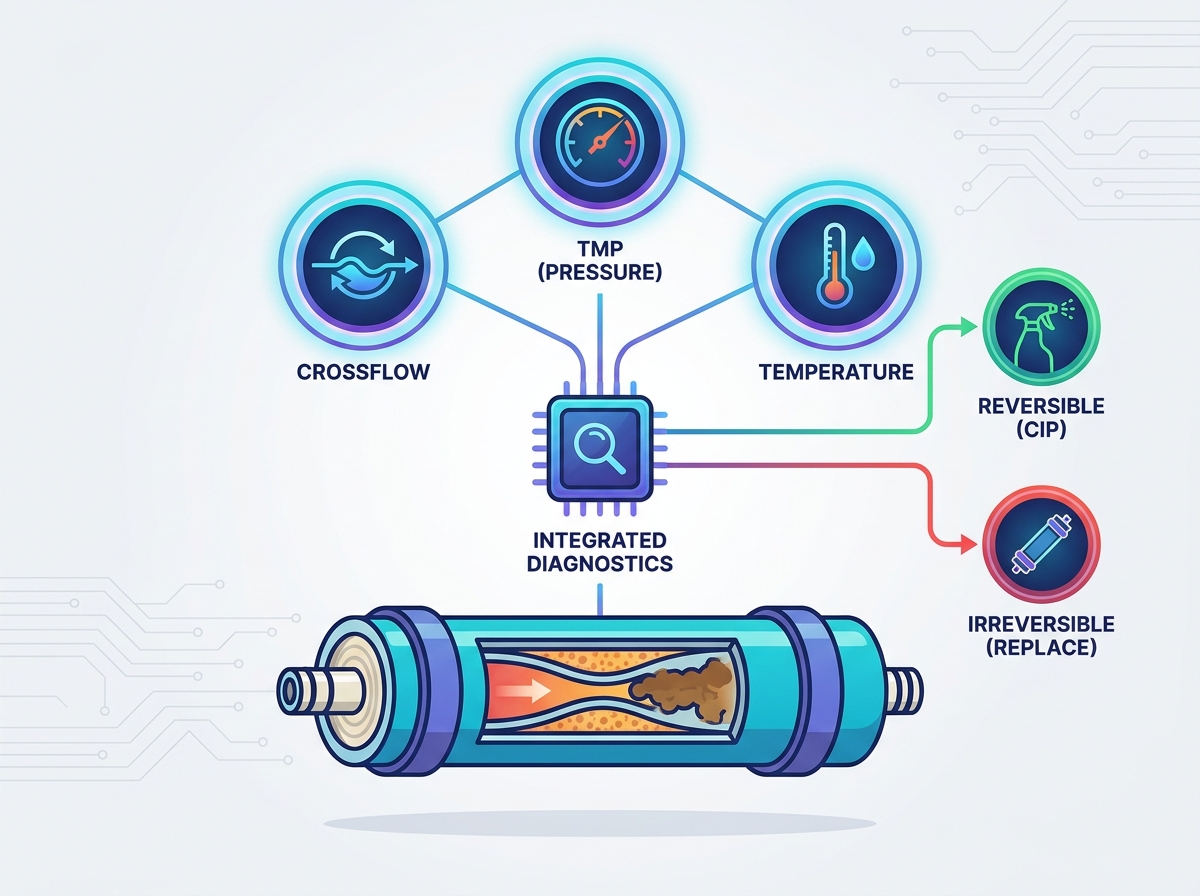
You cannot fix a system unless you accurately measure its variables. Decoding system performance requires tracking crossflow velocity, TMP, and temperature together. You must view them as a connected ecosystem.
Crossflow Velocity vs. Permeate Flow: Crossflow velocity actively controls the thickness of the concentration polarization layer. We often call this the surface cake layer. Higher velocities sweep debris away from the pores.
Diagnostic lens: Monitor both flows simultaneously for accurate insights. If crossflow remains stable but permeate drops, fouling is actively occurring. If the crossflow itself is dropping, look elsewhere. Pump issues or sudden feed viscosity changes are likely the real culprits. Check your impellers and feed tanks first.
Transmembrane Pressure (TMP) Dynamics: TMP serves as the ultimate primary indicator of membrane health. You must track it daily and plot the historical trends.
Diagnostic lens: Watch the exact rate of pressure change. A rapid spike in TMP during constant flow indicates acute fouling. A slow, creeping TMP baseline after cleaning points to irreversible fouling. This creeping baseline tells you the internal pores are slowly dying.
Temperature and Viscosity Corrections: Fluid dynamics follow strict physical rules regardless of your equipment brand. Lower temperatures directly increase fluid viscosity. Higher viscosity artificially lowers flux. This happens without any actual physical fouling occurring on the surface.
Evaluation step: Always calculate the Temperature Corrected Flux first. Do this before altering any process parameters. Complete this calculation before scheduling any unplanned CIP routines. Normalizing your data prevents panic and wasted chemical usage.
Not all fouling requires a brand new replacement module. You must learn to distinguish between reversible surface buildup and irreversible internal damage. Making this distinction saves your maintenance budget.
First, you need a strict method for assessing CIP effectiveness. You must measure flux recovery carefully post-cleaning. Perform a standard alkaline and acid washing cycle. Check the baseline TMP immediately afterward. If you cannot restore your original baseline TMP, the fouling is transitioning. It is becoming a permanent, irreversible problem.
Next, focus your efforts on identifying pore plugging. You must differentiate between a simple surface cake layer and internal blockages. Minor crossflow adjustments and regular backwashing easily manage surface cake layers. Internal pore plugging is much harder to fix. Incompatible feed chemistries often cause this deep plugging. Severe mineral scaling inside the matrix is another common cause.
Some systems also deploy enzymatic cleaners for stubborn biological fouling. However, enzymes require strict pH and temperature controls. If your feed contains heavy metals, enzymes might fail completely. You must tailor your chemical recovery strategy to your exact foulant profile.
Finally, establish a clear threshold for action. You need a solid, data-driven tipping point. Calculate your ongoing chemical cleaning costs. Add up your total downtime expenses for the quarter. Compare these operating figures against the capital expenditure of buying new elements. When monthly cleaning costs exceed the annualized replacement costs, you must upgrade. Holding onto dying equipment only drains your operational budget.
Fouling Type Comparison Guide
Fouling Type | Primary Cause | Diagnostic Indicator | Correction Strategy |
|---|---|---|---|
Reversible (Cake Layer) | High suspended solids | Rapid flux drop, stable baseline TMP post-CIP | Increase crossflow, optimize CIP schedule |
Irreversible (Pore Plugging) | Scaling, chemical incompatibility | Creeping baseline TMP, failed CIP recovery | Evaluate new membrane material or replace |
Eventually, every filter reaches the end of its useful life. You need clear, objective criteria to evaluate a new tubular membrane module.
Knowing exactly when to shortlist replacements saves immense frustration. Do not wait for a catastrophic module failure. Outline specific failure scenarios in your preventative maintenance plan. For example, evaluate new modules if flux recovery drops below 60% post-CIP. Frequent structural fiber breakage also justifies immediate replacement research.
Material science and chemical tolerance are crucial decision factors. Material selection serves as the primary evaluation dimension for high-stress environments. Standard polymers fail quickly under harsh industrial conditions. You should heavily evaluate the specific advantages of a PVDF membrane element (Polyvinylidene fluoride). PVDF offers exceptionally high mechanical strength. It boasts superior resistance to highly aggressive CIP chemicals like chlorine. It withstands strong acids and corrosive bases easily. This chemical resilience ensures an extended lifespan in brutal wastewater conditions.
Geometry and channel size also demand your strict attention. You must evaluate the inner diameter (ID) specifications carefully. Base your choice on the total suspended solids (TSS) of your specific feed stream. Consider the raw fluid viscosity as well. Choosing the correct ID prevents future plugging. A wider channel handles higher solids much better.
Ask your vendor for detailed case studies. Request data from facilities processing similar wastewater streams. Reviewing external data provides a realistic expectation for module longevity. You want proven results, not theoretical lab data.
Buying new equipment always introduces new engineering challenges. You must carefully manage implementation risks during a system upgrade. You cannot assume a new brand will drop perfectly into an old skid.
System Compatibility (Footprint & Fittings): Address the engineering reality of retrofitting head-on. Ensure your new modules perfectly match the existing housing dimensions. Verify all manifold connections and pipe fittings. Check the hydraulic limits of your current skid layout. Mismatched fittings cause immediate leaks and dangerous pressure drops.
Pump Capacity Constraints: Upgrading to a different membrane material alters the system hydraulic profile. Changing the pore size does the exact same thing. Verify your existing feed and circulation pumps thoroughly. They must maintain the required crossflow velocity constantly. They must do this without experiencing destructive cavitation.
Next-Step Actions (Piloting): We strongly advise against blind procurement practices. Never buy based purely on a glossy spec sheet. If you plan to switch to a new tubular microfiltration membrane, run side-stream pilot testing. Test the unit for 30 to 60 days minimum. Use this trial to verify vendor claims regarding flux stability. Confirm the expected CIP recovery rates before committing to a full-scale plant rollout.
Diagnosing tubular filtration issues requires a highly comprehensive approach. You must read flow, TMP, and temperature together as a single, integrated dataset. Isolating just one variable leads to costly operational errors.
We highly encourage facilities to establish a strict temperature-corrected baseline. Document this clean baseline during your first week of operation. Once you confirm irreversible fouling, change your strategy immediately. Shift your focus away from futile cleaning cycles. Instead, start evaluating chemically resilient replacement modules.
Do not wait until your system completely fails and shuts down production. Consult an application engineer today to review your historical system data. They can help you conduct a proper, scientific pilot test. They will also help you evaluate specific PVDF replacements tailored for your facility. Taking proactive steps today saves thousands in unexpected downtime tomorrow.
A: Sudden drops usually stem from unexpected process upsets. Spikes in feed solids or a sudden influx of oil and grease are common culprits. A failure in the pretreatment phase can also lead to acute cake layer compaction. These events quickly overwhelm the membrane surface, blocking permeate flow.
A: You use standard viscosity correction factors to adjust your raw data. Engineers typically normalize this data to a baseline of 20°C or 25°C. Applying a correction formula separates normal temperature effects from actual physical fouling. This ensures you only react to genuine membrane blockages.
A: PVDF is ideal when your existing polymeric membranes degrade prematurely. High-temperature feeds and abrasive solids destroy weaker materials. If your process demands highly aggressive, high-pH chemical cleaning routines, PVDF is the best choice. Its chemical resilience dramatically outlasts standard materials in harsh wastewater environments.
A: Yes, many vendors offer drop-in replacements for standard systems. However, buyers must rigorously verify the exact module dimensions. You must check O-ring placements and housing tolerances. You also need to confirm complete hydraulic compatibility with your current feed and circulation pumping infrastructure.