close
Choose Your Site
Global
Social Media
Views: 0 Author: Site Editor Publish Time: 2026-11-26 Origin: Site


Method developers face a highly critical frustration. They often discover unexpected peaks in a blank solid-phase extraction (SPE) sample. Analysts routinely call these ghost peaks. These rogue signals appear abruptly. They completely disrupt otherwise flawless analytical runs. You thought your method was robust. The chromatogram tells a completely different story.
Contaminated blanks directly compromise analytical integrity. They halt batch processing immediately. Such failures trigger stressful compliance audits. Laboratories must then conduct costly assay repeats. Without a clear troubleshooting path, teams waste days. They blindly guess the source of the interference.
Resolving these peaks demands a systematic approach. You must isolate variables carefully. We will guide you through this determination process. You need to know if the issue stems from the extraction protocol. It might come from solvent quality. Alternatively, manufacturing materials of the SPE consumables themselves could be failing. You will learn exactly how to pinpoint the culprit. We will show you how to restore confidence in your analytical results.
Establish a true baseline: Differentiate between liquid chromatography (LC) system contamination and true SPE-introduced artifacts before altering your extraction method.
Isolate consumables: Test the cartridge housing, sorbent bed, and SPE frit independently to identify the exact source of polymer leachables or unreacted monomers.
Audit reagent concentration: Understand how solvent evaporation steps amplify trace impurities, necessitating strict evaluation of LC-MS grade solvent vendors.
Prioritize material transparency: When evaluating new SPE vendors, demand stringent lot-to-lot reproducibility data and verify the composition of their chromatography filter discs and housing polymers.
False positives create severe headaches in analytical testing. Baseline disturbances frequently originate from the analytical instrument itself. These system artifacts mask the actual performance of your sample preparation method. Analysts often blame the SPE process prematurely. They discard expensive consumables before checking the instrument. You must verify system cleanliness first.
To achieve success, establish clear criteria for baseline verification. You need to prove the LC or GC system operates flawlessly. We recommend two distinct verification steps:
Injection of a True System Blank: Run the starting mobile phase directly through the column. Do not use any SPE intervention. This step rules out carryover. It also exposes dirty injector valves or typical column bleed.
Gradient Elution Check: Assess your chromatogram during specific gradient shifts. Peaks often appear only when the organic composition increases. This behavior usually points to aqueous mobile phase contamination. It rarely indicates an SPE process failure.
Mitigating risk requires a disciplined approach. Never discard SPE lots immediately. You must first confirm your LC/GC system is clean. We see many labs prematurely switch vendors. They do this without a verified baseline. This mistake wastes departmental budget. It severely delays your time-to-result. You must treat SPE blank contamination as a secondary suspect until you clear the instrument.
Best Practice: Always run a zero-volume injection. This isolates injector rotor seal wear.
Common Mistake: Skipping the system blank to save time. This leads to hours of misguided troubleshooting.
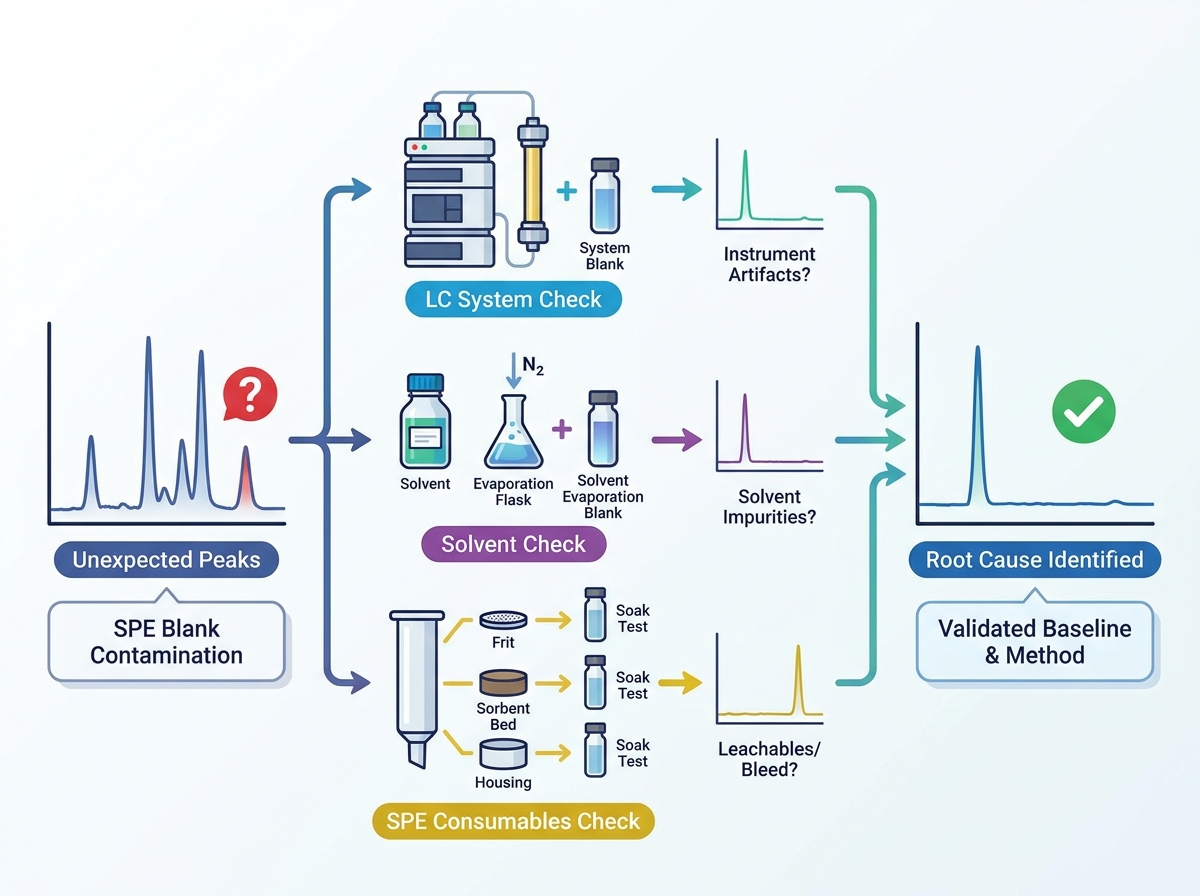
Troubleshooting requires analyzing overlooked components. The SPE frit is frequently ignored. Manufacturers often make these frits from sintered polyethylene (PE) or PTFE. They act as a hidden culprit for contamination. They release plasticizers, slip agents, or unreacted oligomers. These leachables interfere heavily during sensitive mass spectrometry runs.
Testing the chromatography filter disc demands a targeted approach. You must isolate it completely from the sorbent and the plastic housing.
The Frit Soak Test: Extract the frit from an unused cartridge. Use clean metal tweezers. Do not introduce skin oils. Soak it in your strongest elution solvent. Pure methanol or acetonitrile works best. Leave it submerged for 24 hours. Inject this solvent into your LC-MS. You will easily spot any leachable profiles.
Material Evaluation Criteria: Compare standard polyethylene frits against advanced alternatives. Chemically inert PTFE often performs significantly better. Glass fiber variants also provide excellent background cleanliness. You must evaluate the background noise each specific material produces.
Implementing these material changes requires careful consideration. Upgrading to a high-purity laboratory porous filter element often increases your per-unit cost. However, this upgrade pays off rapidly. It drastically reduces failure rates. Highly sensitive LC-MS/MS or GC-MS applications strictly demand this level of purity. You preserve your budget overall by avoiding massive assay repeats.
Best Practice: Always request comprehensive frit material documentation from your vendor.
Common Mistake: Assuming all polymer frits share the exact same chemical inertness. Sintering processes vary wildly across manufacturers.
Solvents trick analysts frequently. A solvent appears perfectly clean during a direct injection. It then fails catastrophically during the actual SPE process. This happens due to the concentration effect. The drying or evaporation phase amplifies trace impurities aggressively. A 1 mL elution volume might evaporate down to 50 microliters. You just concentrated any hidden impurities by a factor of 20.
Conducting a solvent evaporation blank provides immediate clarity. It mimics the exact physical stress your solvents undergo. Follow these steps meticulously:
Take the exact volume of elution solvent used in the assay. Do not use a larger or smaller aliquot.
Evaporate it under nitrogen to dryness. Do this exactly as dictated by the protocol. Maintain your standard temperature settings.
Reconstitute the dried residue. Use your starting mobile phase. Inject this directly into the analytical instrument.
Vendor evaluation becomes hyper-critical here. You must assess chemical suppliers rigorously. Look closely at their non-volatile residue (NVR) specifications. High NVR values virtually guarantee ghost peaks. If the evaporation blank shows these peaks, you found your problem. The optimal solution is upgrading the solvent grade. You do not need to replace the SPE cartridge.
Best Practice: Use ultra-high purity nitrogen for all evaporation steps. Check the manifold needles. Dirty gas lines introduce their own unique contaminants.
Common Mistake: Blaming the SPE column immediately before testing the evaporation step.
Sorbents themselves sometimes fail us. Polymeric sorbents pose specific chemical risks. Resins like HLB or mixed-mode polymers may leach unreacted monomers into your sample. This happens if manufacturers wash them improperly during large-scale production. Silica-based sorbents carry entirely different risks. They may release bonded phase fragments. Highly acidic or basic conditions often trigger this phase cleavage.
Cartridge housings also present significant analytical challenges. Standard polypropylene tubes readily leach phthalates. They also release stabilizing agents or mold release compounds. Aggressive organic solvents exacerbate this leaching issue. Dichloromethane or hexane extracts these chemicals rapidly. Extended contact times make the background interference much worse.
We must evaluate consumables across multiple physical dimensions. You need a structured approach to select the right materials.
Compare "medical-grade" versus standard polypropylene housings. Medical-grade plastics undergo stricter regulatory oversight. They generally contain far fewer extractable additives.
Implement a strict pre-conditioning wash protocol. Ask yourself: Does a secondary solvent wash eliminate the peak? If yes, update your standard operating procedures (SOPs). You can often optimize the wash step rather than changing vendors entirely.
Shortlisting Logic: Sometimes pre-washing fails completely to clear the background. You must then transition to a premium vendor. Look for suppliers offering glass cartridges. PTFE housings also work perfectly for highly aggressive solvent applications.
Housing / Frit Material | Chemical Compatibility | Extractables Risk Level | Best Laboratory Use Case |
|---|---|---|---|
Standard Polypropylene / PE | Moderate (Aqueous / Mild Organics) | High (Phthalates, Slip Agents) | Routine testing, low-sensitivity UV assays. |
Medical-Grade PP / Pure PE | Good (Broad Organics) | Low to Moderate | Standard LC-MS/MS, routine clinical diagnostics. |
Glass Housing / PTFE Frit | Excellent (Aggressive Solvents) | Extremely Low | Trace environmental analysis, Hexane/DCM extractions. |
Method stability relies entirely on your laboratory supply chain. Lot-to-lot reproducibility ultimately defines a good vendor. A sudden appearance of background contamination acts as a loud alarm bell. It often signals a covert change in the manufacturer's raw material supplier. They switched base polymers to save costs. You inherited the resulting analytical headache.
Protecting your lab requires a strict vendor evaluation checklist. Ask these probing questions before committing to a bulk purchase:
Do they provide comprehensive Certificates of Analysis (CoA)? A robust CoA must include dedicated background extractables testing.
Are they completely transparent about their sourcing? You need to know exactly where their sorbents and frits originate.
What is their official notification policy? They must proactively inform you regarding any changes in raw polymer suppliers.
Take definitive next-step actions. Request validation samples from three distinct manufacturing lots. Do this before approving any new SPE product. Regulated methods demand this high level of scrutiny. Run all three lots through your complete isolation framework. Test the frits, the housings, and the sorbent beds comprehensively.
Best Practice: Establish a fully validated secondary approved vendor. Supply chain disruptions happen frequently.
Common Mistake: Approving a vendor based on a single flawless demonstration lot. The second production lot usually reveals the true manufacturing quality.
Unexpected peaks demand a highly methodical troubleshooting approach. We must rely on a strict, evidence-based exclusion process. You start by clearing the LC instrument of any carryover. You then evaluate the solvent concentration effects. Finally, you dissect the individual SPE components.
Investing time in this audit process pays massive dividends. You must evaluate the frit, sorbent, and solvent individually. This proactive diligence ensures robust method development. It protects your laboratory's data integrity fiercely. Furthermore, it significantly simplifies your future procurement decisions.
Moving forward, update your standard operating procedures immediately. Include mandatory frit soak tests for all new consumable approvals. Mandate solvent evaporation blanks before validating any new analytical assay. By isolating these variables, you eliminate guesswork entirely. You ensure your analytical runs remain pristine, reliable, and fully compliant.
A: Contamination typically stems from trace impurities in the elution solvent that are amplified during the evaporation step, or from polymer leachables originating from the frit or cartridge housing.
A: Remove the frit, soak it in your elution solvent, evaporate the solvent, reconstitute, and inject. If the target ghost peak appears, the laboratory porous filter element is the absolute source.
A: Yes. Modifying the conditioning step to include a higher percentage of strong organic solvent can often flush out unreacted monomers or manufacturing artifacts before the sample is loaded.
A: Consider glass housings and PTFE frits when extracting with highly non-polar or aggressive solvents (like hexane or DCM) that readily extract plasticizers from standard polypropylene tubes.