close
Choose Your Site
Global
Social Media
Views: 0 Author: Site Editor Publish Time: 2026-10-24 Origin: Site


Sudden pressure spikes, stalled extractions, and inconsistent flow rates immediately compromise analytical workflows and delay critical results. When fluid dynamics fail mid-extraction, you risk losing irreplaceable samples. Unpredictable SPE cartridge flow problems lead to irrecoverable sample loss, decreased laboratory throughput, and compromised data reproducibility. These failures directly impact cost-per-sample metrics and force technicians to waste hours repeating extractions. Moving from reactive, ad-hoc fixes to a systematic approach requires understanding the mechanical and chemical causes of frit blockages. You must identify exactly why these porous barriers fail under pressure. This knowledge enables laboratories to implement standardized prevention protocols and select the correct cartridge architectures tailored to specific sample matrices. By addressing the root causes of flow restriction, analytical teams can restore predictability to their sample preparation workflows and eliminate the guesswork from solid-phase extraction.
Matrix Preparation is Critical: The majority of frit blockages stem from inadequate upstream sample preparation, specifically unfiltered biological or environmental matrices.
Identify the Blockage Type: Differentiating between reversible matrix precipitation and irreversible sorbent bed collapse dictates whether a sample can be salvaged.
Hardware Specifications Matter: Selecting the appropriate frit porosity (e.g., 20 µm vs. 10 µm) and material (PTFE, polyethylene, or stainless steel) is a critical decision-stage factor for complex matrices.
Proactive Economics: Investing in pre-filtration or centrifugation yields a higher ROI than absorbing the labor and consumable costs associated with recurring clogged chromatography frits.
Defining optimal flow rates is the foundational step in diagnosing extraction failures. Solid-phase extraction typically requires a steady, controlled flow of 1 to 5 mL/min. Maintaining this baseline pressure threshold ensures reproducible analyte retention during the loading phase and complete recovery during elution. If the flow rate drops below 1 mL/min due to restriction, target analytes may diffuse improperly through the sorbent bed, leading to broad elution bands and poor recovery. Conversely, if technicians apply excessive vacuum to force liquid through a partial blockage, the flow becomes too fast, and analytes fail to interact with the stationary phase entirely. Consistent fluid dynamics guarantee that every sample experiences the exact same chemical environment and contact time during the extraction process.
The frit performs a highly specific dual role within the cartridge architecture. First, it acts as a physical barrier to retain the stationary phase, preventing the packed sorbent from washing out into the collection tube. Second, it serves as a flow distributor, allowing uniform liquid dispersion across the entire cross-section of the sorbent bed. A standard frit is not a simple screen; it is a porous, tortuous barrier. Most standard frits are manufactured from sintered ultra-high-molecular-weight polyethylene (UHMWPE) or polytetrafluoroethylene (PTFE). The sintering process creates a complex, three-dimensional network of microscopic channels. Fluid must navigate these winding channels, which naturally trap particulate matter by design. When these channels become overloaded, the frit ceases to function as a distributor and becomes a bottleneck.
Identifying early warning signs prevents catastrophic flow failure and allows technicians to intervene before a sample is lost. SPE column frit clogging rarely happens instantly without prior indicators. You must train laboratory personnel to recognize the physical symptoms of impending blockage.
Channeling: Fluid forces its way through a single path of least resistance, bypassing the majority of the sorbent bed and leaving dry pockets visible through the cartridge wall.
Uneven Meniscus Dropping: Across a multi-position vacuum manifold, certain cartridges drain significantly slower than their neighbors under the exact same vacuum pressure.
Persistent High Pressure: Automated extraction systems trigger over-pressure alarms or require maximum pump output to maintain baseline flow rates.
Sudden Resistance: The liquid level completely stalls, refusing to drop even when maximum vacuum or positive pressure is applied to the manifold.
Suspended solids and cellular debris physically occlude frit pores, acting as the most frequent cause of extraction failure. Environmental particulates, such as silt, clay, and organic matter in surface water samples, cause rapid and irreversible contamination. Similarly, biological matrices like whole blood, uncentrifuged plasma, or tissue homogenates contain massive amounts of cellular debris. When you load these raw matrices directly onto a cartridge, the particulates immediately blind the upper frit. The microscopic channels within the polyethylene disc fill with solid debris. Once these pores are physically packed, fluid can no longer pass. This physical occlusion forms a concrete-like layer over the frit, completely sealing the cartridge from further fluid movement.
Solvent switching causes immediate and severe in-cartridge precipitation. Loading a highly aqueous biological sample onto a highly organic conditioned bed is an extremely risky protocol error. This solvent mismatch causes rapid protein precipitation directly upon contact. Furthermore, salt crystallization occurs on the upper frit if buffer concentrations in the sample exceed their solubility limits when introduced to the organic conditioning solvent. This chemical blockage is sudden. Unlike physical particulates that build up gradually, precipitated proteins form a sticky, impermeable film across the entire surface of the frit in seconds. This proteinaceous film seals the cartridge so effectively that vacuum manifolds become completely useless, and positive pressure systems will simply blow the seals before pushing the liquid through.
Manufacturing variations and mechanical stress create sorbent fines in SPE. Mechanical shock during shipping, dropping boxes of cartridges, or aggressive handling fractures brittle silica or polymeric sorbents. This fracturing creates micro-particles, often smaller than 5 µm. During the conditioning or loading phases, these fines migrate downward through the interstitial spaces of the packed bed. They eventually reach the lower frit and blind it from the inside out. When the lower frit clogs, flow stops from the bottom up. This specific type of blockage is notoriously difficult to diagnose because the upper frit appears completely clean and unobstructed to the naked eye.
Aggressive solvents degrade specific frit materials, while extreme pH levels destroy the sorbent itself. Chlorinated solvents, for example, can swell certain low-grade polymer frits. As the polymer swells, the internal pore size shrinks, restricting flow without any physical particulates present. High pH environments cause stationary phase collapse. Silica-based sorbents begin to dissolve and hydrolyze at pH levels above 8. This dissolution destroys the structural integrity of the packed bed. As the silica breaks down, it forms a dense, gelatinous mass that restricts all flow paths and permanently binds to the lower frit. Chromatography frit blockage often stems from these chemical mismatches rather than physical debris.
Blockage Type | Root Cause | Visual Symptom | Reversibility |
|---|---|---|---|
Physical Occlusion | Unfiltered matrix particulates (silt, cells). | Visible debris layer on the upper frit. | Low. Usually requires sample transfer. |
Protein Precipitation | Aqueous sample hitting organic solvent. | Cloudy, sticky film on the upper frit. | Moderate. Can sometimes be solubilized with buffer. |
Lower Frit Blinding | Sorbent fines migrating downward. | Flow stops, but upper frit looks completely clean. | Zero. Cartridge must be discarded. |
Polymer Swelling | Incompatible aggressive solvents. | Gradual flow restriction across the entire batch. | Zero. Requires different frit material. |
Silica Hydrolysis | Sample or wash pH exceeds 8.0. | Bed appears collapsed or gelatinous. | Zero. Analyte retention is destroyed. |
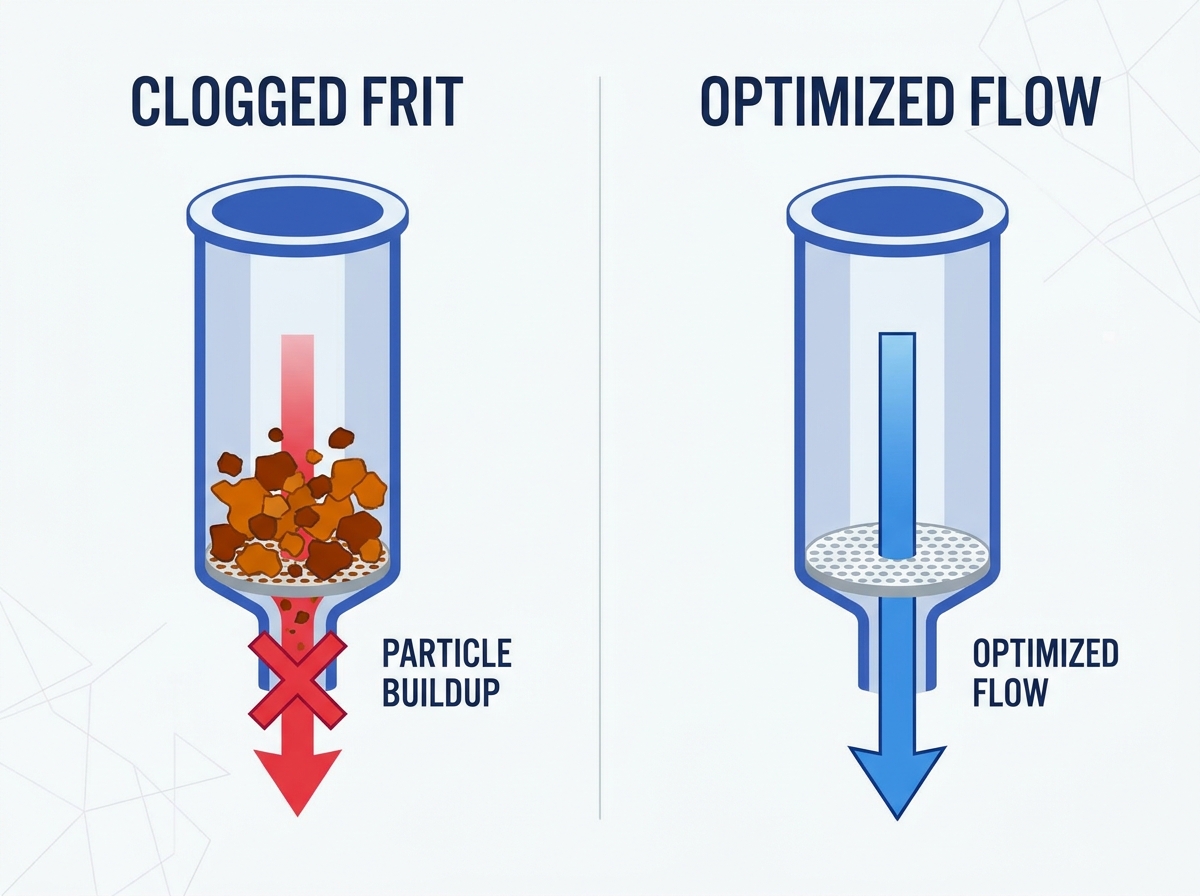
Temporarily reducing the flow rate setting is your first line of defense. You must execute this at the very first sign of fluid resistance. Lowering the pressure prevents the hard-packing of particulates into the frit pores. If you apply maximum vacuum immediately upon seeing a slowdown, you force the debris deeper into the tortuous path of the frit, wedging the particles permanently into the polyethylene matrix. This makes the blockage irreversible. A slower flow rate allows the liquid to find alternative microscopic channels through the partially obstructed barrier, keeping the extraction alive.
Transitioning from vacuum manifolds to positive pressure systems offers massive operational advantages for viscous matrices. Positive pressure forces samples through the cartridge evenly from above. It prevents bed channeling by applying uniform gas pressure across the entire liquid meniscus. Vacuum systems, conversely, pull from the bottom. When resistance increases, a vacuum manifold creates a severe pressure gradient that actively compacts the sorbent bed downward. This compaction squeezes the interstitial spaces closed and exacerbates the flow restriction. Positive pressure systems maintain fluid momentum without compressing the stationary phase, making them vastly superior for challenging samples.
Reversing flow gently can dislodge upper frit blockages, but it requires strict mechanical control. You must execute this without disturbing the packed sorbent bed. Effective SPE column frit troubleshooting relies on finesse, not brute force. Isolate the affected cartridge from the manifold. Attach a clean syringe to the bottom luer tip. Gently push a small volume of air or low-pressure nitrogen up the column from the bottom port. This momentarily vents the blockage and lifts the particulate layer off the upper frit, allowing the liquid to bypass the clog. Do not apply sustained high pressure from the bottom, as this will eject the sorbent entirely out of the top of the cartridge.
Targeted chemical washes can remove specific matrix interferences if physical occlusion is not the root cause. If you suspect protein precipitation, utilize mild chaotropic agents or adjust the pH of your wash solvent to solubilize the proteins back into the liquid phase. Select a mobile phase that dissolves salt crystals without eluting your target analytes. For example, a low-concentration aqueous buffer wash can clear salt blockages caused by highly organic loading conditions. You must understand the exact chemical nature of the precipitate to select the correct wash solvent. Blindly applying strong solvents will simply wash your analytes into the waste stream.
Manual physical intervention carries extreme risks and should be avoided. Attempting to scrape the upper frit with a spatula, glass rod, or pipette tip is highly discouraged. Piercing the frit ruins the extraction entirely. These actions cause massive sample contamination by introducing foreign material. They also damage the column bed irreversibly, creating massive channels that destroy analyte retention. If chemical washes and pressure adjustments fail, the cartridge is usually beyond recovery. Physical manipulation of the frit guarantees poor recovery, high background noise, and irreproducible data.
Evaluating the operational differences between frit porosities is essential for robust method development. Standard 20 µm frits offer superior flow characteristics for viscous samples like plasma or heavy environmental extracts. However, they carry a higher risk of fine migration, allowing microscopic sorbent particles to pass into the final extract and potentially damage downstream HPLC equipment. Conversely, 10 µm frits provide exceptionally clean extracts by trapping smaller debris. The trade-off is a significantly higher risk of SPE frit particle buildup. You must balance these factors based on the known particulate load of your specific matrix.
Sorbent morphology directly impacts frit performance and overall flow reliability. Spherical polymeric sorbents produce very few fines during manufacturing and transport. They pack uniformly, creating consistent interstitial spaces that promote even, predictable flow. They also offer a much wider pH tolerance, remaining stable from pH 1 to 14. Irregular silica-based sorbents, while excellent for specific polar interactions, fracture easily under mechanical stress. These irregular particles contribute heavily to lower frit blinding. They are also prone to bed collapse under extreme pH conditions, which instantly halts fluid movement and ruins the extraction.
Integrated glass fiber depth filters act as an internal guard column for your SPE cartridge. These pre-frit technologies sit directly above the primary polyethylene frit. They handle heavy particulate loads by trapping larger debris before it ever reaches the restrictive pores of the main frit. Depth filters possess a nominal pore size, allowing them to capture a wide range of particle sizes throughout their thick matrix, rather than just on the surface. This prevents irreversible contamination of the main bed and ensures consistent flow even with highly challenging environmental or biological samples.
Design Feature | Specification | Primary Advantage | Flow Risk / Limitation |
|---|---|---|---|
Frit Porosity | 20 µm (Standard) | Accommodates viscous matrices; maintains faster flow rates under vacuum. | Higher risk of sorbent fines passing into the final elution extract. |
Frit Porosity | 10 µm (Fine) | Produces highly particulate-free extracts; protects downstream HPLC columns. | Highly susceptible to rapid physical occlusion and sudden pressure spikes. |
Sorbent Type | Spherical Polymeric | Uniform packing; wide pH stability (1-14); minimal fine generation. | Requires careful solvent selection to prevent polymer swelling in certain beds. |
Sorbent Type | Irregular Silica | High surface area for specific analyte interactions; excellent for normal phase. | Prone to fracturing; high risk of lower frit blinding; highly pH sensitive. |
Pre-Filter | Glass Fiber Depth Filter | Traps large particulates before they hit the primary frit; prevents surface sealing. | Increases total dead volume; may require slightly larger elution volumes. |
Mandating strict upstream sample preparation mitigates the primary source of clogs before the sample ever touches the cartridge. You must implement rigorous centrifugation protocols for biological matrices. Spinning whole blood or tissue homogenates at >10,000 x g for 10 minutes effectively pellets cellular debris and high-molecular-weight proteins. For environmental water samples, utilize syringe filtration (e.g., 0.45 µm PES filters) prior to SPE loading. Removing suspended solids upfront is the single most effective way to maintain consistent fluid dynamics. Skipping these preparatory steps guarantees eventual frit failure and sample loss.
Adjusting dilution ratios prevents in-situ precipitation and chemical blockages. Modify your conditioning and loading solvents to ensure complete mobile phase compatibility. If you are extracting plasma, dilute the sample 1:1 with an aqueous buffer before loading. This prevents the proteins from crashing out when they contact the conditioned sorbent bed. Standardizing these extraction protocols removes the chemical variables that cause sudden blockages. A clogged chromatography frit is frequently the result of a protocol failure, rather than a defective consumable.
Evaluating the operational impact of premium, clog-resistant cartridges is necessary for effective laboratory management. Compare the upfront investment of cartridges with integrated depth filters against the hidden costs of extraction failures. Sample loss is incredibly expensive, especially for limited clinical, forensic, or environmental specimens that cannot be recollected. Repeated extractions waste technician labor, consume additional high-purity solvents, and delay reporting. Instrument downtime destroys lab efficiency. Investing in proper pre-filtration steps or advanced cartridge architectures ultimately saves massive amounts of time by ensuring a higher success rate per batch.
SPE column frit clogging is a systemic symptom of mismatched sample preparation, incorrect cartridge specifications, and flawed extraction protocols. To eliminate these flow failures and secure your analytical workflow, implement the following actions immediately:
Audit your current sample preparation workflows to verify that centrifugation speeds and syringe filtration steps adequately remove particulates before loading.
Transition from vacuum manifolds to positive pressure systems when processing highly viscous biological or environmental matrices to prevent sorbent bed compaction.
Revise your loading protocols to include proper sample dilution, ensuring aqueous matrices do not precipitate upon contact with organic conditioning solvents.
Upgrade to SPE cartridges featuring integrated glass fiber depth filters or spherical polymeric sorbents if your current failure rates exceed acceptable baseline metrics.
A: Switch from a vacuum manifold to a positive pressure system to apply uniform force. Reduce the flow rate setting immediately to prevent hard-packing the blockage. If protein precipitation is suspected, apply gentle warming or a mild aqueous buffer wash. If the upper frit is irreversibly blocked, carefully transfer the liquid to a new, pre-conditioned cartridge.
A: No. In solid-phase extraction, cartridges are strictly single-use to prevent sample carryover and cross-contamination. Physical cleaning is impractical and highly risky for data integrity. Attempting to wash or scrape a disposable SPE frit will damage the sorbent bed and compromise the recovery of your target analytes.
A: Sorbent fines are microscopic particles created when the stationary phase fractures. This is caused by mechanical abrasion during shipping, poor manufacturing quality control, or aggressive drying steps that crack the sorbent bed. These fines migrate downward during fluid flow and permanently blind the lower frit.
A: There is an inverse relationship between pore size and clogging risk. Smaller pores trap more matrix particulates, resulting in cleaner extracts but clogging much faster. Larger pores resist physical occlusion better but may allow microscopic sorbent fines or small debris to pass through into the final extract.
A: Positive pressure is significantly better. It provides uniform, forceful flow that pushes viscous samples through the frit without compacting the sorbent. Vacuum manifolds pull from the bottom, creating a pressure gradient that compresses the stationary phase and exacerbates flow restrictions when resistance occurs.
A: Replace the column when pressure adjustments and safe backflushing fail to restore flow. If chemical washes risk eluting your target analytes, discard the cartridge. You must also replace it when irreversible particulate contamination is visible or when stationary phase collapse occurs due to high pH or severe solvent incompatibility.