close
Choose Your Site
Global
Social Media
Views: 0 Author: Site Editor Publish Time: 2026-05-27 Origin: Site


Industrial environments, particularly in manufacturing, packaging, and automation, often experience noise levels that are not only disruptive but also harmful to both equipment and personnel. Pneumatic machines, which are commonly used in these settings, are notorious for producing loud, harsh noise during operation. This noise is not just a nuisance; it can also lead to hearing damage, reduce productivity, and contribute to an uncomfortable working atmosphere. However, there is a simple yet highly effective solution to this problem: the plastic muffler.
A plastic muffler is designed to reduce the noise produced by pneumatic machines by controlling the exhaust air flow, turning a previously noisy process into a quieter one. In this article, we’ll explore how plastic mufflers work, their advantages over other types of mufflers, their ideal applications, and what you should consider when selecting one for your systems.
Pneumatic machines, which use compressed air to operate, often generate significant noise due to the rapid release of high-pressure air. This sudden release results in a series of air turbulence and shock waves that create the loud, "hissing" sound typically associated with pneumatic systems.
Several factors contribute to the noise level in these systems:
Exhaust port design: The design of the exhaust port plays a significant role in how the air escapes, affecting the volume of the noise produced.
Release speed: The faster the air is released, the higher the noise level.
Pressure and pipe sealing: Poor pressure regulation and improper sealing of pipes and joints also lead to noise, as air escapes unintentionally.
The impact of this noise is far-reaching. Not only does it affect the workers who may suffer from long-term hearing damage, but it also creates an uncomfortable work environment, reducing overall productivity. Noise pollution can even result in costly legal implications in some industries if safety regulations are not met.
Plastic mufflers are designed to absorb and reduce the noise generated by the exhaust air of pneumatic machines. Their structure typically includes a housing made from durable, lightweight plastic, with a porous or permeable material inside. This material is often made of plastic or resin, and it helps to dissipate the sound waves and reduce the noise intensity.
As the compressed air is released through the muffler, it passes through the porous material or expansion chamber. This process causes the air to slow down and spread out, significantly reducing the turbulence and sound waves associated with the exhaust. The result is a quieter operation without significant performance loss in the pneumatic machine.
When properly designed, a plastic muffler can offer a perfect balance between reducing noise and maintaining airflow efficiency. This is particularly important for systems that require a steady and controlled exhaust, as any restrictions in the air flow could impact the overall performance.
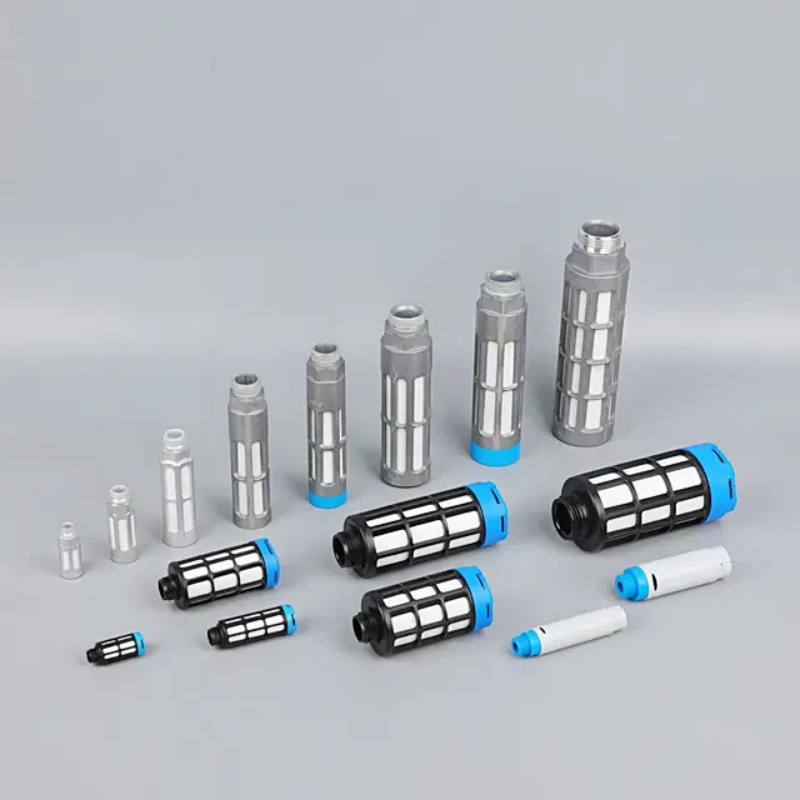
Plastic mufflers are a popular choice for many applications, but how do they compare to other muffler types, such as metal mufflers?
Lightweight and Cost-Effective: Plastic is significantly lighter and less expensive than metals like bronze or stainless steel. This makes plastic mufflers ideal for low to medium pressure pneumatic systems where cost efficiency is crucial.
Corrosion Resistance: Unlike metal mufflers, plastic mufflers are highly resistant to moisture, chemicals, and other corrosive elements. This makes them particularly suitable for environments like food processing, medical equipment, and light industrial applications where metal parts may corrode over time.
Effective Noise Reduction: Research has shown that plastic mufflers can reduce noise levels from as high as 120 dBA to about 90 dBA, depending on the system's design and operating conditions. This level of noise reduction is comparable to other types of mufflers but without the added weight or cost.
Ease of Installation and Maintenance: Plastic mufflers are easier to install and maintain, particularly in retrofit applications. Whether you're integrating them into new systems or replacing old mufflers, plastic mufflers are a quick and cost-effective solution.
Plastic mufflers are ideal for a variety of industries that rely on pneumatic systems. Here are some typical applications where they prove to be especially beneficial:
Many packaging lines utilize pneumatic actuators and valves, which require frequent exhaust cycles. Using a plastic muffler in such systems can drastically reduce environmental noise, creating a more comfortable and safer working environment for employees.
In automated assembly lines and robotics, where multiple machines often operate in close proximity, controlling noise levels is crucial. Plastic mufflers can significantly reduce the noise produced by exhaust air in these high-density environments, improving safety and reducing worker fatigue.
Laboratories and medical environments require strict control over both noise and air purity. Plastic mufflers provide a solution by reducing exhaust noise and ensuring that no harmful particles or contaminants are released into the environment.
When selecting a plastic muffler for your pneumatic system, there are several factors you should consider to ensure optimal performance:
System Pressure and Flow: The muffler must be able to handle the maximum pressure and flow rate of your pneumatic system. Choosing a muffler that supports your system's operating conditions will prevent potential issues like restricted airflow.
Interface Size and Type: Make sure that the muffler you choose is compatible with the exhaust port of your equipment. Most mufflers are available in threaded, push-in, or snap-on versions, so you need to select the one that fits your system.
Filtration Needs: If your pneumatic exhaust contains oil mist or particulate matter, you may want to consider a muffler that includes a filter. This will help to capture these contaminants before they are released into the environment.
Maintenance and Replacement: Regular maintenance is essential for ensuring that the muffler continues to perform well. Check for any blockages or degradation in the material, as this can affect both airflow and noise reduction efficiency.
In conclusion, plastic mufflers are an essential component in reducing the noise produced by pneumatic systems. Their lightweight, cost-effective design, coupled with their superior corrosion resistance, makes them ideal for a variety of industrial applications. Whether you are working with packaging machinery, automation systems, or medical equipment, using a plastic muffler can enhance the working environment by reducing noise and improving air quality.
When choosing a plastic muffler, it’s important to consider factors such as system pressure, flow rate, and whether filtration is needed. Selecting the right muffler for your pneumatic system will ensure that you achieve the best possible performance without sacrificing noise control.
If you are looking to improve the efficiency and comfort of your pneumatic packaging machines or other automated equipment, plastic mufflers offer a high-quality solution. Contact us today to learn more about our plastic muffler options and find the perfect fit for your needs.
Q1: What are plastic mufflers made of?
Plastic mufflers are made from durable plastic materials such as polypropylene, polyethylene, or polyvinylidene fluoride. These materials are chosen for their light weight, corrosion resistance, and ability to reduce noise effectively.
Q2: How much noise can a plastic muffler reduce?
Plastic mufflers can reduce noise levels by up to 30 dBA, depending on the design and operating conditions. In some cases, noise levels can be reduced from as high as 120 dBA to around 90 dBA.
Q3: Can plastic mufflers be used in all pneumatic systems?
Yes, plastic mufflers can be used in most low to medium-pressure pneumatic systems. However, it's important to choose a muffler that matches your system's pressure and flow requirements for optimal performance.
Q4: How do I maintain a plastic muffler?
To maintain a plastic muffler, regularly check for blockages and ensure that the material inside is not degraded. If the muffler is part of a filtration system, replace the filter element as needed to maintain efficient operation.