close
Choose Your Site
Global
Social Media
Views: 0 Author: Site Editor Publish Time: 2026-09-15 Origin: Site


Industrial facilities face a constant dual challenge. You must reduce pneumatic exhaust noise to meet strict workplace compliance standards, such as OSHA regulations. Simultaneously, you need to maintain optimal machine cycle times to hit daily production targets. This creates a core tension in your component selection process. Facility managers constantly balance noise reduction, procurement budgets, and the dangerous risk of inducing backpressure.
While metal options certainly exist, selecting the right plastic silencer offers highly specific advantages. It delivers superior corrosion resistance and upfront cost-efficiency. Provided you respect its operating limits, it can completely transform your pneumatic exhaust management strategy. We will explore how to specify, size, and maintain these essential components properly. By following this guide, you will protect both your workforce's hearing and your core machinery's lifespan.
Material Limitations: Plastic silencers excel in corrosive and standard industrial environments but require strict adherence to temperature and pressure ceilings.
Performance Balance: The primary evaluation metric is the ratio of noise reduction (decibels) to exhaust flow restriction (backpressure).
Lifecycle Cost: Porous plastic models are consumable items; replacing them on a schedule prevents costly equipment downtime and cylinder damage.
Specification Matching: Exact thread sizing and flow capacity (SCFM) matching are non-negotiable for system safety.
Engineers must critically analyze the cost-to-performance ratio across different materials. Sintered bronze and stainless steel carry a notably higher unit cost. Plastic presents a massive economic advantage for high-volume deployments. If your facility runs hundreds of automated pneumatic cylinders, the savings scale rapidly. You achieve similar decibel reduction at a fraction of the upfront procurement cost.
Next, consider corrosion and chemical resistance. Porous plastic models easily outperform brass in wet environments. Washdown areas in food processing plants destroy brass components quickly. Facilities handling airborne chemicals also see far better longevity from plastic units. Brass oxidizes and degrades, while industrial-grade polyethylene remains structurally intact under harsh chemical exposure.
However, we must conduct a transparent risk assessment. Plastic does have specific limitations. You should never install it in high-impact zones where flying debris strikes the port. Temperatures exceeding 175°F (80°C) will melt or deform the polymer body. Extreme high-pressure surges typically above 150 PSI can rupture standard plastic models. You must specify metal if your application exceeds these thresholds.
Finally, evaluate weight considerations. End-of-arm tooling requires minimal mass. Moving pneumatic assemblies perform better when you reduce their payload. Heavy components increase motor wear and slow down robotic movements. A polymer-based unit drastically cuts the weight at the exhaust port compared to stainless steel.
Material Application Comparison Chart
Material | Corrosion Resistance | Max Temperature | Best Application Environment |
|---|---|---|---|
Porous Plastic | Excellent | 175°F (80°C) | Washdown zones, robotics, standard factory floors |
Sintered Brass | Moderate | 300°F (149°C) | High-heat areas, non-corrosive general pneumatics |
Stainless Steel | Excellent | 400°F+ (204°C+) | Extreme pressure, heavy impact zones, chemical baths |
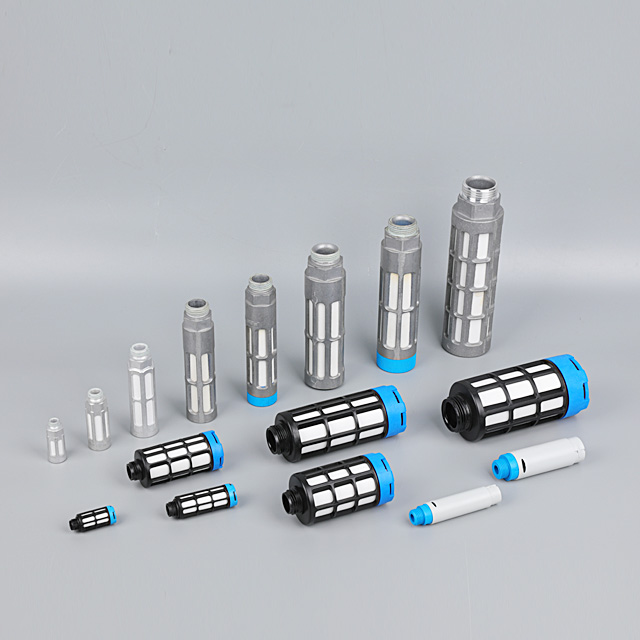
Evaluating a pneumatic air exhaust muffler requires strict attention to manufacturer flow data. Relying on guesswork often leads to erratic machine behavior.
Flow rate and backpressure define your success. We measure flow capacity using the Cv factor. You must ensure the component provides adequate volume for the escaping air. It should never choke the pneumatic cylinder's exhaust. Choked exhaust leaves residual air pressure acting against the piston. This slows down cycle times drastically. It directly reduces your overall machine efficiency and daily output.
Noise reduction ratings serve as your primary compliance metric. OSHA sets an 85 dB safety threshold for an eight-hour shift. Manufacturer data shows exact decibel (dB) reduction curves. You must read these charts carefully. Ensure the output reliably drops below this legal safety threshold. Because decibels operate on a logarithmic scale, even a 3 dB reduction cuts the sound energy in half.
Thread standards dictate secure and safe installation. You must match port threads exactly to prevent leaks. A mismatched thread causes dangerous air blowouts. NPT threads feature a specific taper designed for North American standards. BSPT and G-Threads rely on different sealing geometries popular in Europe and Asia. Verify your manifold port standard before ordering any inventory.
Installation requires a delicate touch. A common implementation failure is over-torquing. Mechanics often apply too much force to polymer threads. This easily shears the components right off inside the valve block. Extracting a broken plastic thread costs valuable production time. Always hand-tighten these units initially. Use a wrench only for a final quarter-turn seal.
Micron ratings also matter heavily. The porosity of the material dictates two vital things. It controls both dirt trapping and noise diffusion. Finer pores trap more noise but clog significantly faster. Coarser pores resist clogging but allow louder exhaust pops. You must strike a balance based on your air quality.
A massive misconception exists in pneumatic system design. Many maintenance technicians believe port size alone dictates the required model size. This is dangerous. You must evaluate the actual exhaust volume in SCFM (Standard Cubic Feet per Minute) or L/min. A tiny 1/4-inch port might vent a massive volume of stored pressurized air. Always size a plastic muffler for air compressor applications based on actual peak flow rates, never just the thread diameter.
Space envelope constraints often dictate your final physical choice. Control cabinets offer very little room for bulky additions. Manifold blocks pack solenoid valves tightly together. You must evaluate the physical dimensions closely. Low-profile flat designs fit tight spaces beautifully. Standard conical shapes protrude further but offer significantly more surface area for air diffusion. Check your clearance before ordering.
Application variations change your selection logic entirely. Continuous exhaust behaves differently than intermittent rapid exhaust. Air compressor blow-off valves release air constantly over long durations. This continuous flow requires massive surface areas to prevent freezing caused by rapid air expansion. Conversely, solenoid valves release rapid, violent bursts of air. These intermittent bursts require robust structural integrity to handle the repeated shockwaves.
Every pneumatic silencer faces the unavoidable clogging hazard. We must understand the exact mechanism of failure. Compressor oil mist, factory dust, and particulate matter enter the exhaust stream. They slowly fill the porous microscopic network over time. This gradually increases system backpressure. Left unchecked, this backpressure will destroy internal cylinder seals and stall automated movements.
Visual inspection triggers help prevent catastrophic failure. You can use visual indicators as a reliable baseline. New polymer models look bright white, vivid blue, or clear black. As they absorb oil and dirt, they change color entirely. Severe discoloration serves as a mandatory trigger for your maintenance schedule. Do not wait for a machine to slow down.
Let us look at the replacement versus cleaning ROI. The economic argument heavily favors total replacement. The unit cost of these exhaust components remains incredibly low. Conversely, maintenance labor costs run exceptionally high. The hourly wage paid to a technician to remove, soak, scrub, and dry a clogged unit almost always exceeds the cost of a brand-new part. Establish these items as strict, non-repairable consumables.
Creating a preventative schedule protects your expensive machinery. You should track cycle counts or elapsed calendar days. Replace them proactively. Changing them before backpressure spikes will save you from replacing expensive upstream directional valves and linear actuators.
Follow this actionable framework to streamline your component selection process. Taking shortcuts here usually leads to poor machine performance.
Step 1: Audit Operating Parameters. Document your maximum system pressure accurately. Record the peak exhaust flow expected during rapid cycling. Note the maximum ambient temperature limits of your facility.
Step 2: Establish the Baseline Requirement. Set a hard target for dB reduction to satisfy safety officers. Determine the maximum acceptable backpressure limits for your specific machine to keep cycle times fast.
Step 3: Request Testing Samples. Procurement teams should acquire small batches of shortlisted models. Test them directly in situ. Measure the actual cycle time impact using a stopwatch or PLC data feedback.
Step 4: Assess Vendor Supply Chain. Evaluate your suppliers carefully on stock consistency. Look for bulk availability. These are high-turnover consumable components. You cannot afford to wait six weeks for basic replacements.
A polymer-based exhaust solution remains a highly effective, economical choice. When specified correctly against pressure, flow, and environmental constraints, it outperforms metal in both cost and corrosion resistance. It keeps your workplace quiet and your maintenance budget intact.
We urge buyers to always prioritize flow capacity over maximum noise reduction. Protecting your core pneumatic machinery from backpressure damage is paramount. An overly restrictive unit might be whisper-quiet, but it will inevitably ruin your production speeds.
Take action today to audit your current equipment. Contact your engineering support team for sizing assistance, download a technical specification sheet, or request a product sample to begin in-house testing immediately.
A: Standard models generally handle pressures up to 150 PSI safely. If your system operates above this limit or experiences violent pressure spikes, they can crack or rupture. You should upgrade to stainless steel or heavy-duty brass for extreme high-pressure applications.
A: In the industrial pneumatics industry, manufacturers use the terms interchangeably. Both refer to the exact same component designed to diffuse exhaust air and reduce noise. There is no technical difference between them regarding function or internal design.
A: Replacement timelines depend entirely on your air quality and cycle volume. Visually inspect them monthly. If they appear severely discolored or coated in oil, replace them immediately. Doing this prevents backpressure from building up and damaging your cylinders.
A: A correctly sized unit will not slow down your cylinder at all. It will provide enough flow capacity to vent air instantly. However, an undersized or heavily clogged unit will restrict exhaust flow, causing backpressure that absolutely slows down actuation.